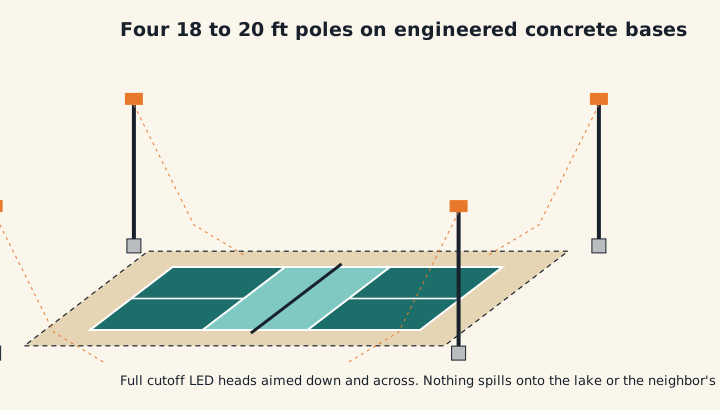
The standard setup
Four poles, one near each corner and outside the fence line, 18 to 20 feet tall, each carrying one full cutoff LED fixture of about 150 to 200 watts aimed down and across the court. That delivers roughly 30 footcandles on the playing surface, which is plenty for backyard play, with the light stopping within a few feet of the slab edge. Two poles on one side can work for a court that only gets occasional evening use, with some shadowing at the far sideline.
Full cutoff matters. A fixture with a flat lens and a shielded housing puts light on the court and nowhere else. The old style floods on a bracket put half their light into the neighbor's bedroom and the other half onto the lake, and in Winter Park and the lakefront towns that gets a complaint and sometimes a code letter.
The pole base
A 20 foot pole with a fixture on top is a lever in a hurricane. In Orange and Seminole counties the base is engineered for the wind load: typically a concrete pier 18 to 24 inches across and 4 to 6 feet deep in sand, with anchor bolts set in a template. Direct burial fiberglass poles are an alternative and go deeper. Either way the pole is outside the court slab, never cast into it, so a swaying pole cannot crack the court.
Wiring and permits
Lights are an electrical permit, pulled by a licensed electrician, in every jurisdiction in the metro: City of Orlando, unincorporated Orange County, Seminole County, Winter Park, Lake Mary and the Town of Windermere. The run from the house is usually a dedicated 20 amp circuit in conduit buried 18 inches, with a weatherproof switch and a timer at the court. Distance to the panel is what moves the price; a court 150 feet from the garage costs more to wire than one 40 feet away. A sub panel at the court makes sense if a shade structure or a fan is coming later.
HOA and neighbors
Most architectural review boards in Lake Nona, Hunter's Creek, Keene's Pointe and the Seminole County communities want three things: a plan showing pole locations and heights, fixture cut sheets proving full cutoff, and a photometric drawing showing less than half a footcandle at the property line. Your builder's lighting supplier produces that drawing. Boards also commonly set a curfew, 10 pm being typical, and a timer handles it.
On lake lots, aim fixtures so none point toward the water. Several Orange County lake communities have dark sky language in their covenants, and a light on the water at night is the fastest way to find out.
Cost
Four poles, LED heads, bases, wiring and permit run $9,000 to $18,000 for a pickleball court in the Orlando metro, with distance to the panel and the photometric plan as the big variables. Two poles run $5,000 to $9,000. The cost page shows where that sits in the whole budget, and the construction page shows when in the schedule the poles go in: during the concrete cure, so the court is lit the day the lines dry.
Straight answers
How many lights does a backyard pickleball court need?
Four poles with one LED head each is standard and gives even light across the court. Two poles on one side work for occasional use with some shadowing at the far sideline.
Do I need a permit for court lights in Orange County?
Yes, an electrical permit pulled by a licensed electrician, in the County and in every city in the metro. The pole bases may also be reviewed for wind load as part of the court permit.
Will the lights bother my neighbors?
Not if the fixtures are full cutoff, mounted at 18 to 20 feet and aimed down. The photometric plan the HOA asks for shows the light at the property line, which should be under half a footcandle.