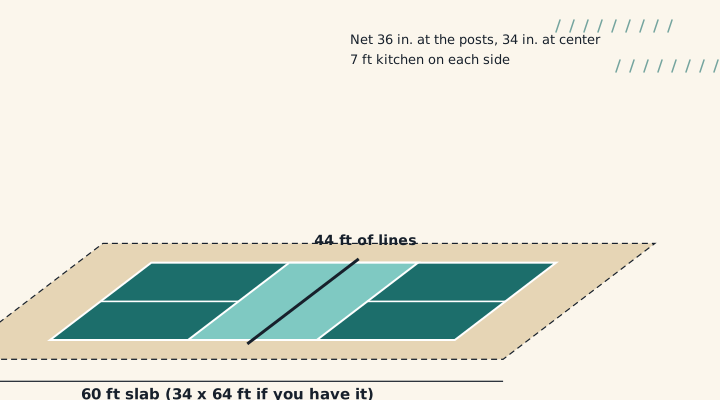
The numbers
- Lines: 20 feet wide by 44 feet long. Same for singles and doubles.
- Kitchen (the no volley zone): 7 feet on each side of the net.
- Net: 36 inches high at the posts, 34 inches at the center. Posts are 22 feet apart.
- Minimum slab: 30 by 60 feet. That gives 8 feet behind each baseline and 5 feet beside each sideline.
- Preferred slab: 34 by 64 feet. Ten feet of run back and 7 feet at the sides. Tournament play uses more; a backyard does not need it.
Those are the USA Pickleball guidelines, and they match what every builder in the Orlando market works to. A 24 by 50 pad will hold a court for casual play with a short run back; anything smaller and lobs go into the fence.
Orientation
Long axis north to south. In central Florida the sun sits low in the southern sky for most of the day from November through February, and a court laid east to west puts it in one player's eyes every afternoon. North to south splits the problem to a few minutes at sunrise and sunset. If the lot only allows east to west, a 10 foot fence with a dark windscreen on the west end helps, and the fencing guide explains why that screen comes down in June.
Measuring an Orlando lot
Measure the rectangle you can actually use, which is smaller than the yard. Subtract:
- Easements. Most lots platted since the 1980s carry a 10 to 15 foot drainage and utility easement along the rear line, and lake lots often have a maintenance easement too. Nothing gets built in them. The recorded plat on the Orange County or Seminole County property appraiser's site shows the widths.
- Setbacks. Accessory structures have side and rear setbacks that vary by zoning district; 5 feet is common for a slab, more for a fence over 6 feet or a light pole. The permits guide covers who to ask.
- The pool cage and any septic drain field. A court cannot sit on a drain field, and the cage needs a few feet of clearance for maintenance.
- Tree drip lines. A live oak's roots run to its drip line and beyond. Pouring a slab over them heaves it; cutting them can kill a protected tree.
What is left is the court rectangle. If it is 30 by 60 or larger, you have a court. If it is 26 by 54, you have a recreational court and a decision to make.
Typical lots around the metro
A quarter acre lot in Oviedo, Avalon Park or Winter Garden with a 2,500 square foot house and a pool usually has room for a 30 by 60 court across the back if the easement is 10 feet, and often does not if it is 15. Half acre lots in Dr. Phillips, Longwood and the older parts of Lake Mary almost always have room. Acre plus lots in Windermere, Heathrow and east Orange County have room for a court and a half court on separate pads. Lake Nona's newer neighborhoods run tight; a 34 by 64 court there usually means no pool.
What the slab sits on
Size settles the footprint. What goes under it is the other half of the plan, and on Florida sand it is where courts go right or wrong: the drainage and base guide explains the layers, and the pickleball court construction page walks through the build in order.
Straight answers
Can I fit a pickleball court on a quarter acre lot?
Often, yes, if the rear easement is 10 feet and the pool is not already across the back. A 30 by 60 slab needs a usable rectangle that size after easements and setbacks; measure before you budget.
How close to the property line can a court be?
The slab typically needs a 5 foot setback and cannot enter a drainage easement, which puts most courts 15 to 20 feet off the rear line. Exact numbers depend on the zoning district and the jurisdiction.
Is 30 by 60 really the minimum?
For a court that plays like a court, yes. A smaller pad means lobs end in the fence and dinks at the sideline have no room. We build 26 by 54 when the lot forces it and tell the homeowner what they are giving up.