The ground
Most of Orlando sits on fine sand, often 20 feet or more of it, over the limestone of the Floridan aquifer. Soil surveys call it Myakka, Immokalee, Candler, Tavares depending on the neighborhood. The high sandy ridges, like the land under College Park and the Dr. Phillips ridge, drain fast and stay dry. The flatwoods toward the east and south, like Meadow Woods, Lake Nona's older sections and much of Oviedo, hold a water table within a couple of feet of the surface in the wet season.
Sinkholes get the headlines. Orange County is at the eastern edge of the state's sinkhole belt and the Florida Geological Survey puts most of the metro in its sand covered zone, where sinkholes are small and slow. Winter Park's Lake Rose, which opened in 1981, is the famous one. A court does not create sinkhole risk and a soil probe is not a sinkhole test; what we are checking for is softer and more common.
That is organic soil. Orlando is built around hundreds of lakes and old wetland basins, and lots near them, on the Butler chain, the Winter Park chain, Lake Conway and dozens of others, can have peat or muck under the first foot of sand near the shore. A court over peat settles unevenly and no slab design fixes it. On lakefront lots we probe the footprint with a rod before anything is ordered. If we hit muck, the court moves or the muck comes out.
Above the lawn
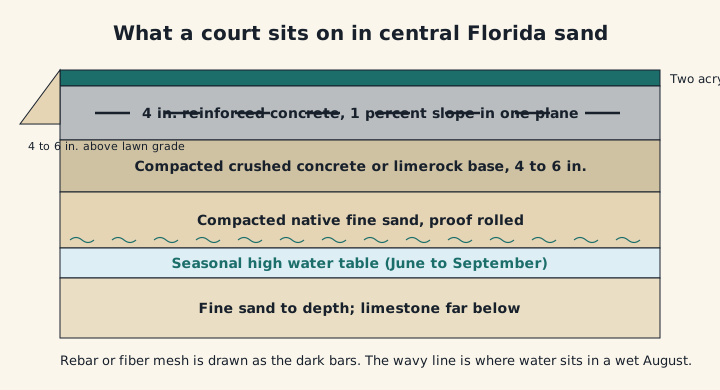
The single most important decision: the finished slab sits 4 to 6 inches above the surrounding grade. A court poured at lawn level holds water against its edges after every storm, grows mildew by August and loses its base to wash out at the low corner. Raising it means fill, and fill means compaction in lifts and a proof roll. A 30 by 60 pad raised six inches takes about 35 cubic yards of clean fill; on a high sandy lot in Winter Park it may need none.
The layers
- Subgrade. Sod and roots stripped, native sand compacted to 95 percent in 6 inch lifts. If the roller pumps, it is too wet and we wait a day.
- Base. Four to six inches of crushed concrete or limerock, compacted. It spreads the load, gives water a path, and keeps the slab off the sand.
- Vapor barrier. Optional under a court; a slab that breathes is fine outdoors. Skipped unless an engineer asks.
- Slab. 4 inch reinforced concrete, poured in one plane with a 1 percent fall. One inch of drop per 10 feet, 6 inches across a 60 foot court. The construction page covers the pour and cure.
Where the water goes
A 30 by 60 slab sheds about 1,100 gallons in a one inch rain, and summer afternoons here drop two inches in an hour a few times a season. That water has to leave the way the lot already drains: toward the street, a rear swale, or the retention pond. It cannot go toward the house, the pool deck or the neighbor. The slope is set on the first visit by watching where the yard is wet the morning after a storm. If the low side is the house side, a shallow swale along the court's downhill edge, graded to the easement, solves it. A French drain is rare but sometimes needed on a flat lot with nowhere for a swale to go.
Note the easement rules. Rear drainage easements in Orange and Seminole counties exist so stormwater can move between lots. The court stays out of them, and a swale that ties into one is doing what the plat intended.
What this costs
Site prep, fill and base together run $4,000 to $12,000 of a $22,000 to $34,000 court, depending mostly on how much the pad has to rise and whether a truck can reach the back. It is the least visible money in the project and the hardest to add later. The cost page shows the lines.
Straight answers
Will my pickleball court flood in the rainy season?
Not if it sits above grade with a 1 percent fall to a swale. Water leaves a sloped slab in minutes. Courts that pond were poured flat at lawn level, and the fix is a new pad, not a coating.
Do I need a soil test before building a court in Orlando?
On most upland lots, no; compacted sand over a crushed base is proven. On a lakefront or former wetland lot, a probe for organic soil before ordering concrete is cheap insurance against a slab that settles.
Is a vapor barrier needed under a court slab?
Not for an outdoor court. The slab is exposed on top and can dry in both directions. Engineers sometimes specify one; otherwise the base is the moisture control.