Heights that make sense
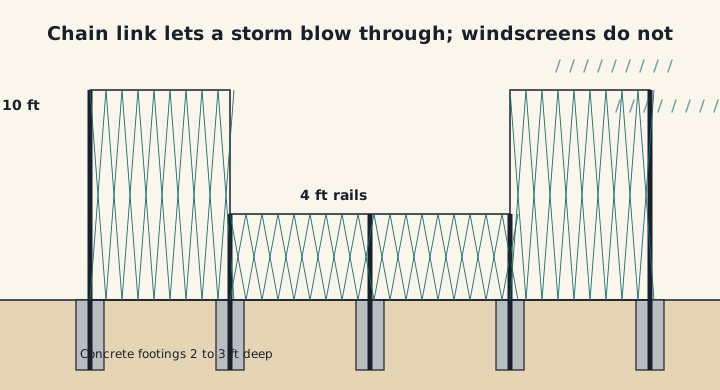
Ten feet behind each baseline, where the lobs and overheads go. Four feet along the sidelines, which keeps the yard open and keeps balls from rolling into the pool. A full 10 foot perimeter is the tennis standard and a lot of HOA courts use it, but on a backyard court it adds $5,000 to $8,000 and makes the yard feel like a cage. The court size guide explains why the ends need the height more than the sides.
Materials
Black vinyl coated chain link is what most courts get. It disappears visually, costs the least, and lets wind pass through, which is the important part in a storm. Aluminum picket fencing matches a pool enclosure and HOA guidelines in Windermere and Dr. Phillips often prefer it; it costs about twice as much and the pickets have to be tight enough that a ball will not slip through. Wood and vinyl privacy fences are solid panels that catch wind, and we do not use them as court fencing in Florida.
Footings for wind
The Florida Building Code lets fences up to 6 feet be built to a standard wind design. Over 6 feet, the fence is a structure: it needs a building permit in the City of Orlando, in unincorporated Orange County, in Seminole County and in the towns, and the posts and footings get sized for the design wind speed at the site. In practice that means terminal and line posts in concrete footings 24 to 36 inches deep and 10 to 12 inches across in sand, heavier gauge posts on the 10 foot sections, and bracing at the corners. A fence with posts driven into bare sand lies down in the first tropical storm.
Chain link under 6 feet does not need a building permit in the City of Orlando; in unincorporated Orange County even a low fence gets a zoning permit. The permits guide sorts out the offices.
Windscreens: the hurricane season rule
A windscreen on the west end stops the low sun and cuts the breeze across the court. It also turns an open fence into a sail. The screens we hang are rated for wind, mounted with breakaway ties, and still come down the first week of June and go back up after the season ends on November 30. Leaving a screen up through a named storm is how a 10 foot fence ends up in the neighbor's pool, and most fence warranties say so.
Noise
If a neighbor's lanai is within 40 or 50 feet, acoustic panels on the facing fence section knock 8 to 12 decibels off the paddle crack. They are solid, so they are mounted on the same breakaway hardware as a windscreen and come down for the season too. Cushioned acrylic or tile under the ball quiets the court the rest of the way; the surface guide compares them.
Cost
Ten foot ends with 4 foot sides in black chain link, hurricane footings, gate and permit: $8,000 to $16,000 on a 30 by 60 court. Full 10 foot perimeter: $12,000 to $20,000. Aluminum roughly doubles it. These sit in the full budget on the cost page, and the fence goes in during the slab cure according to the construction schedule.
Straight answers
Does a 10 foot court fence need a permit in Orlando?
Yes. Anything over 6 feet is a building permit in the City, in Orange County, in Seminole County and in the towns. The plan shows post sizes and footing depths for wind.
Chain link or aluminum for a court fence?
Chain link stops the ball, costs half as much and lets wind through. Aluminum looks like the pool enclosure and some HOAs require it. Both go on hurricane rated footings.
Can the windscreen stay up all year?
No. Take it down in June and put it back in December. A screen turns the fence into a sail, and the fence warranty usually excludes storm damage with a screen up.